By Mark Pam, Jos
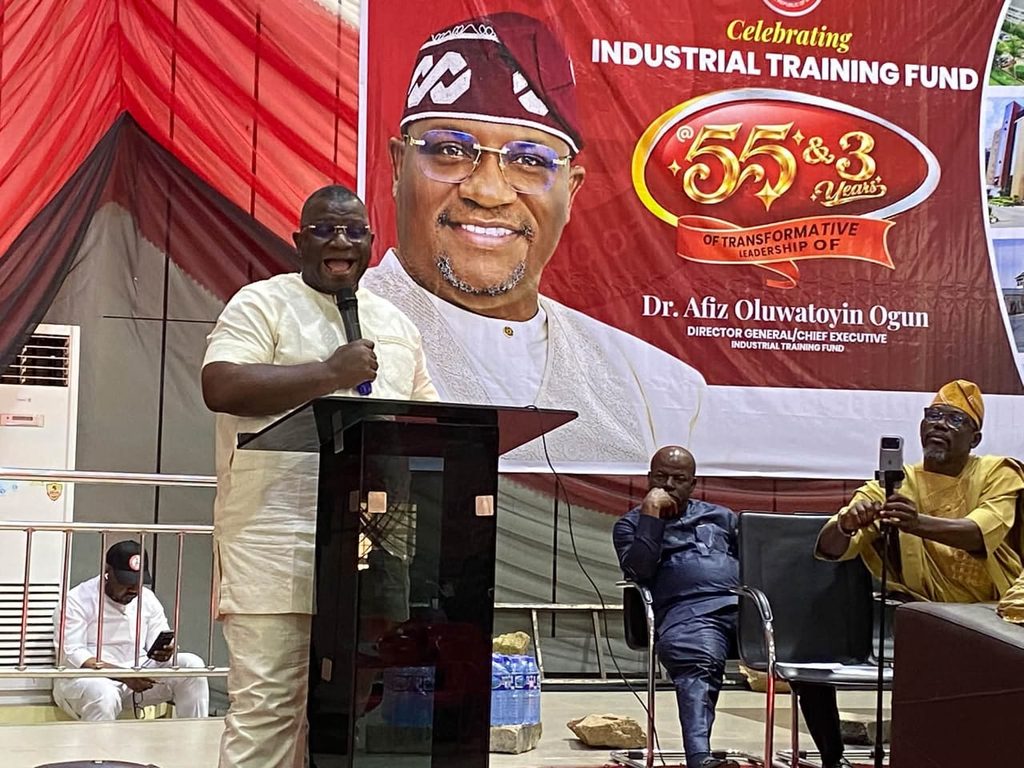
The Industrial Training Fund, ITF, has marked 55th anniversary of its establishment and three years of transformative leadership by the current Director-General and Chief Executive, Dr Afiz Oluwatoyin Ogun, with the Fund highlighting major strides in skills development, digitalisation and workforce transformation.
Speaking at the anniversary celebration held at the ITF headquarters in Jos, Plateau State, Ogun said his administration had repositioned the Fund as a leading institution for skills development, workforce enhancement and national economic growth.
He said the transformation agenda had expanded the Fund’s reach and impact, strengthened local and international partnerships, introduced global standards in vocational education and skills certification, and modernised its operations through digital technology.
Ogun identified the Skill-Up Artisans, SUPA, programme as one of the flagship achievements of his administration, saying hundreds of thousands of artisans had been trained, while another 200,000 were targeted for training in 2026.
He added that more than 7,000 artisans had undergone international certification examinations, while 1,308 training centres were assessed and 776 approved to expand access to quality vocational and technical training.
“Perhaps one of our most significant achievements is the positioning of Nigeria on the global skills map through the establishment of the WorldSkills Academy in Abuja and Nigeria’s admission as the 83rd member of WorldSkills International,” Ogun said.
The DG also highlighted improvements in staff welfare and infrastructure, including promotion and capacity-building programmes, the commissioning of a 47,600-litre fuel station at the Jos headquarters, a staff fuel-card scheme and the renovation and construction of training facilities across the country.
He said his ambition was to build an ITF that would be recognised beyond Nigeria as a leading learning and development institution capable of contributing significantly to national economic growth.
“Personally, I want to see an ITF known across borders as the leading learning and development agency Nigerians can depend on to develop the national economy,” he said.
Also speaking, the Director of Standardisation, Certification and Compliance, Mrs Olayinka Sodunke, said the Fund was positioning itself to create employment opportunities for Nigerians through skills development and vocational training.
Sodunke described the Jos Model Skills Academy as a unique vocational institution in West Africa and stressed the importance of equipping young Nigerians with practical skills, saying, “Skills is the currency of the 21st century.” She disclosed that similar models were being planned for Lagos, the South-East and the Far North.
She also commended the Fund’s progress in digitisation and technology, noting that ITF had moved beyond the era of overhead projectors and cardboard presentations to virtual programmes and modern technological solutions, which she said were preparing the institution for the future.
Similarly, the Managing Director and Chief Executive Officer of the Oil and Gas Free Zone Authority, Alhaji Bamanga Usman Jada, commended Ogun for his developmental strides, saying the ITF had the capacity to transform Nigeria’s growing population into productive human capital.
Jada, who said he was impressed by the facilities at the ITF Centre of Excellence, stressed that Nigeria’s projected population growth made skills, training and innovation critical to sustainable and inclusive industrialisation.
“There is a difference between population and human capital. It is ideas that will help to convert our population into human capital,” Jada said, urging the ITF to sustain its transformation and continue building the skilled workforce required to drive Nigeria’s industrial growth and global competitiveness.